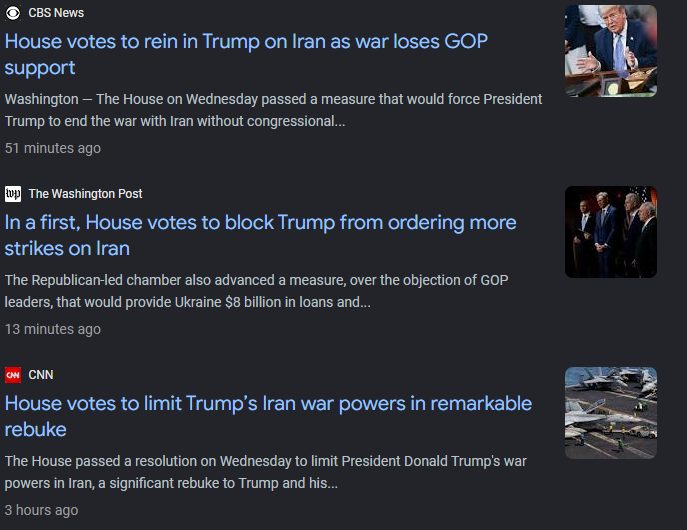
On Wednesday, the US House of Representatives passed a concurrent resolution to, as CNN describes it, "limit President Donald Trump’s war powers in Iran" by a vote of 215 to 208. Four Republicans joined Democrats in voting for the resolution.
According to a Congressional summary of the resolution,
This concurrent resolution directs the President to remove U.S. Armed Forces from hostilities against Iran unless explicitly authorized by a declaration of war or a congressional authorization for use of military force against Iran.
Elements of the U.S. Armed Forces needed to defend the United States, an ally, or a partner from imminent attack are not covered by this requirement provided the President complies with a specified provision of the War Powers Resolution. (The provision generally requires the President to remove U.S. Armed Forces from hostilities no more than 60 days after the President notifies or is required to notify Congress of such involvement, unless Congress authorizes such use. For more information on the War Powers Resolution, see CRS In Focus 13134.)
Concurrent resolutions, from a legal perspective, are essentially garbage, no matter what House aids might whisper to CNN ("A House Democratic aide who has been involved in the effort to pass the war powers resolution told CNN they believe the resolution would be binding and it would be a legal matter to work that out.") According to the Senate's website, concurrent resolutions "must be passed in the same form by both houses, but they do not require the signature of the president and do not have the force of law." [Emphasis added.] They can be "used to express the sentiments of both of the houses." Additionally, in 1983, the Supreme Court issued a ruling that would basically hold that concurrent resolutions that purport to act as binding law are unconstitutional because Congress does not present them to the president for his signature (or veto).
In other words, if the Senate manages to pass the resolution too, it will likely function as nothing more than a written pretty please from Congress. It is likely not binding or enforceable. It will not penalize the President for noncompliance. It makes you wonder why some prominent news outlets are acting like it seriously matters legally or politically.
As usual, Trump took a mild attempt to check his authority well:
Nevertheless, it is very, very unlikely that anything will change even if the Senate passes the resolution as well. The same new outlets that have been regularly telling you for 10 years that this is what finally breaks the Trump fever may tell you that this would serve as a powerful or "remarkable rebuke" to Trump. Why?
Again, in the House, only four Republicans voted for the resolution. Why would Trump care enough to go beyond wailing on social media and actually change his behavior? Yes, his overall approval ratings are brutal, but he still maintains a cultish loyalty among the Republican base and wields significant electoral influence over the Republican party.
Meanwhile, Congress refuses to use its proper legal authority to force the Iran war issue.
The Authority to Initiate Military Action
The war in Iran is illegal. Under Article I, Section 8, of the US Constitution, Congress "shall have Power [...] to declare War." The President has no such authority. Instead, under Article II, Section 2, "The President shall be Commander in Chief of the Army and Navy of the United States, and of the Militia of the several States, when called into the actual Service of the United States." [Emphasis added.] Under our Constitutional framework, Congress chooses when the US initiates military action, and the President then chooses how it is carried out.
Many people, including the President, members of Congress, and people in the news media seem to act like Congress delegated to the President authority to engage in any military activity for at least 60 days when it passed the War Powers Act in 1973. From NPR, for instance,
Under the 1973 War Powers Act, the president has 60 days to end hostilities if there has been no congressional authorization – though he is able to seek a 30-day extension. The same law also gives Congress the ability to end hostilities by voting on a resolution to end military action, subject to presidential veto.
This is asinine. First, as noted, the Constitution grants Congress authority to initiate military action, not the President. Arguably, the Constitution does not give Congress authority to delegate or grant this authority to the President. Second, the War Powers Act does not even purport to grant the authority that many seem to think.
From the "purpose and policy" section of the Act,
The constitutional powers of the President as Commander-in-Chief to introduce United States Armed Forces into hostilities, or into situations where imminent involvement in hostilities is clearly indicated by the circumstances, are exercised only pursuant to (1) a declaration of war, (2) specific statutory authorization, or (3) a national emergency created by attack upon the United States, its territories or possessions, or its armed forces.
[Emphasis added.]
It was Congress's clear intent that the President could only initiate military action if Congress declared war, Congress specifically authorized it in law, or a national emergency was created by an attack on the US. With Iran, there was no Congressional declaration or authorization, and there was no attack on the US (although members of the Trump administration have claimed there was likely going to be an attack by Iran on the US military as retaliation for impending Israeli action).
And then here is the language everyone focuses on,
(b)Termination of use of United States Armed Forces; exceptions; extension period
Within sixty calendar days after a report is submitted or is required to be submitted pursuant to section 1543(a)(1) of this title, whichever is earlier, the President shall terminate any use of United States Armed Forces with respect to which such report was submitted (or required to be submitted), unless the Congress (1) has declared war or has enacted a specific authorization for such use of United States Armed Forces, (2) has extended by law such sixty-day period, or (3) is physically unable to meet as a result of an armed attack upon the United States. Such sixty-day period shall be extended for not more than an additional thirty days if the President determines and certifies to the Congress in writing that unavoidable military necessity respecting the safety of United States Armed Forces requires the continued use of such armed forces in the course of bringing about a prompt removal of such forces.
This provision means that military action properly initiated by the President (Congress-authorized or in response to an attack on the US creating a national emergency) must end within 60 days of a required 48-hour notice unless Congress declares war or authorizes further military action. It does not grant the President 60 days to wage whatever war he wants for any reason he wants.
Congress Has Abandoned Its Responsibilities
In light of the above, the House essentially voted to sternly disapprove of the President's continuation of the war with Iran. This is limp and embarrassing. The authority to initiate war absent an attack on the US belongs to Congress. Congress needs to do something about it to reel in the President, reassert its war authority, and maintain the separation of powers between the branches of government.
Congress has clear Constitutional mechanisms for acting. It could pass a bill or resolution forcing the President to end the war and present it to Trump for his signature. If he vetoes it, Congress could override it by a 2/3 vote.
Congress could use its authority over how government money is spent and refuse to fund the war, the military, and/or other agencies/programs overseen and valued by the President.
Lastly, Congress could simply remove Trump or other top officials from office via impeachment for failing to respect the limits imposed on them by the Constitution and the War Powers Act.
Obviously, none of these will happen in light of the close vote on the resolution in the House and past embarrassing inaction by Congress. A majority of Republican voters are slavishly supportive of everything Trump does, and the Republican members of Congress are cowards electorally beholden to this minority of Americans.
As I have alluded to in the past, our population is civically ill and Congress reflects this. Congress has slowly allowed the President to usurp much of its Constitutional authority, and most of the American public has accepted this. And now that the American people have elected a lawless, wannabe king for the second time, the potential consequences of an improperly enlarged presidency are being fully realized.
Trump will war in whatever ways he wants and for as long as he wants as long as a majority of Republican voters continue to blindly support him. And Congress will limply dither and do nothing substantive to stop him.