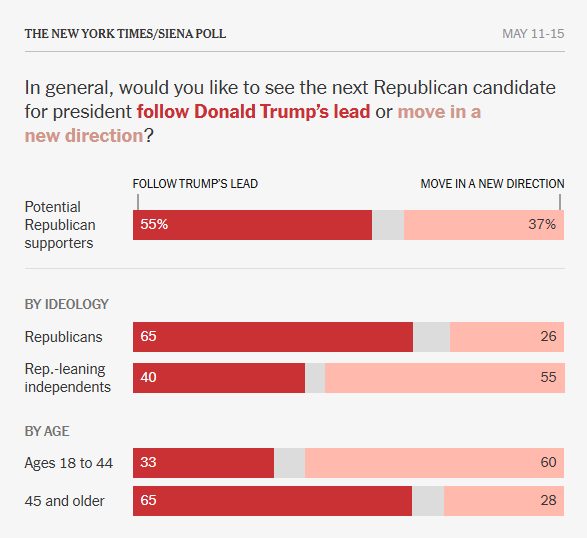
The New York Times and Siena conducted a poll in which they found that a majority of those likely to vote for the Republican Party want the next Republican candidate for president to "follow Trump's lead." Similarly, "Three-quarters of Republicans and Republican-leaning independent voters approve of [Trump's] job performance, the poll found, even as the president’s approval rating among the wider American electorate has fallen to a second-term low of 37 percent."
Trump's tremendous Republican support continues, despite disastrous and often embarrassing policies and actions, such as pardoning convicted seditionists and insurrectionists, unprecedented and open corruption and graft at tax-payers' and supporters' expense, open receipt of foreign bribes, self-glorification, weaponization of the justice system, arbitrary and harmful tariffs, and the use of unqualified federal immigration agents as murderous personal police.
It is not exactly a surprise that his core Republican support remains strong in the face of these issues, as Trump either promised to act in these ways or gave clear indications he likely would.
What may still be a tiny bit surprising is that Republicans continue to largely support Trump despite Trump launching an illegal and rudderless war in Iran that he had publicly opposed, climbing inflation, and blatant disregard for and failure to prioritize (or even consider) the rising cost of living. These were issues on which he campaigned and are ostensibly some of the primary reasons he was elected.
Since 2016, it has been plain as day that Donald Trump sits at the head of a Republican cult of personality. One cannot help but regularly think of Trump's infamous remark during the 2016 campaign as he became aware of the cult forming around him, "I could stand in the middle of Fifth Avenue and shoot somebody, and I wouldn't lose any voters, OK? It's, like, incredible."
What would it take for Republican support for Trump to significantly drop? Perhaps nothing could realistically do it. A significant portion of Trump's supporters seem to be religious-like believers who will reflexively and fervently defend anything he does, but if a supporter were to start having doubts, there are significant intrinsic and extrinsic forces they would need to confront.
Even if some Republican supporters have started harboring doubts or privately wavering in their support of Trump, it seems unlikely that we will see a major shift in his public support. For many, their personal identities, pride, and relationships have become too intertwined with supporting Trump to renounce him. Relinquishing support for him after ten years of political mayhem requires anyone with more than half a brain to reckon with uncomfortable issues and a significant amount of introspection.
How was I so easily duped? Am I a fool? Have I helped damage our culture and trash our civic heritage? Who am I without my slavish devotion to Trump? If I was wrong in my support of Trump, what else am I wrong about?
And then there are the extrinsic factors. What will the people I have surrounded myself with who still love and support Trump say or do if they find out that I no longer believe? Will I be excommunicated from my tribe? How do I face friends and family I renounced or became estranged from because of my beliefs? Would they take me back? Will I belong anywhere?
It is hard enough to leave a cult when you actually want to, but most Trump supporters have shown no interest in breaking free from his cult of personality. Instead, they continue to eagerly swallow and adopt any view he spews out, no matter much it harms them or runs counter to what they claimed to believe. There is no reason to believe this will change any time soon.