In early April, news broke that Elon Musk's SpaceX had filed paperwork with the US government to become a public company with a valuation of $1.75 trillion. In other words, the general public would soon be able to buy shares of the company, which would be publicly tradeable on stock markets.
The SpaceX IPO would likely be the biggest initial public offering of all time as the company seeks to raise $75 billion. [You can read more about the basics here.] This comes on the heals of Musk merging X (aka Twitter) with his artificial intelligence company xAI, which he then folded into SpaceX, thus merging most of his big ventures into one large company.
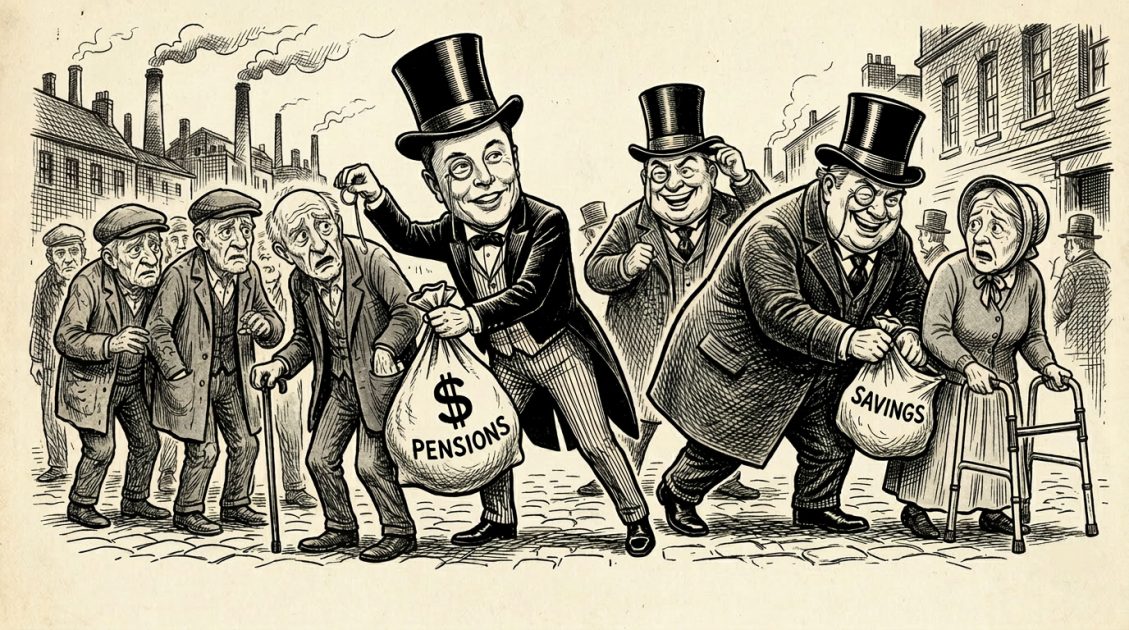
More notably, public index funds, in which many Americans' retirement and pension funds are significantly invested, changed or are considering changing their rules to fast track the inclusion of SpaceX, despite the company losing billions of dollars.
Inflated Value and Suspect Structuring
Some are skeptical that the company is worth anything close to what it is valuing itself at ahead of its initial public offering. Last year, SpaceX lost more than $4.9 billion, and "[i]n the first three months of this year, SpaceX lost almost as much money as all of 2025, recording a $4.3 billion loss," explained the New York Times. Although there is a lot of optimism around some of the technologies SpaceX is working on, including AI, it is a bit unsettling to think that a company that is losing billions of dollars per year may soon be trading as if it is worth $1.75 trillion dollars.
Additionally, there are a number of reasons to view Musk's structuring of the company skeptically from the perspective of regular shareholders, such as a two-tiered share structure, a $1 trillion potential compensation arrangement for Musk, SpaceX choosing a structure that forgoes an independent board, mandatory arbitration for shareholder claims against the company, etc.
But so what? There is nothing new about a company going public at an inflated value. If investors want to take a gamble buying shares of a company they hope will become worth trillions of dollars through AI development and the space business, then so be it.
Index Funds Reduce Their Standards for SpaceX
Well, Americans and their retirement accounts may soon be the ones bearing much of the risk.
It all involves index funds.
An “index fund” is a type of mutual fund or exchange-traded fund that seeks to track the returns of a market index. The S&P 500 Index, the Russell 2000 Index, and the Wilshire 5000 Total Market Index are just a few examples of market indexes that index funds may seek to track.
A market index measures the performance of a “basket” of securities (like stocks or bonds), which is meant to represent a sector of a stock market, or of an economy. You cannot invest directly in a market index, but because index funds track a market index they provide an indirect investment option.
An index fund essentially allows people to invest in the market (or a particular sector of the market) as a whole by simply investing their money in one place.
You pay X dollars to buy into a fund. The people who manage the fund use your money and that of other investors to buy shares of various companies that reflect the market as a whole or a particular sector of the market (such as technology). That way, your money is not tied only to one or a few companies. The main idea is that this is a less risky strategy and that your investment generally increases in value over time as the markets generally increase in value over time.
Retirement and pensions funds are often invested heavily in these types of index funds because they are broad and relatively safe. That is the idea at least. For years, these index funds have only added profitable companies that have been around for long enough to establish at least somewhat of a track record.
This is changing with "index providers relaxing rules written more than two decades ago specifically to keep unprofitable, unproven companies out of the funds millions of Americans rely on for retirement."
After the dot-com crash, index providers tightened their admission standards. In 1999 and 2000, flagship benchmarks scooped up richly valued, money-losing companies near the top, and ordinary savers in passive funds paid the bill when those names collapsed.
So the guardrails went up. To join the S&P 500, a company had to have traded publicly for at least 12 months and posted four consecutive quarters of GAAP profitability (4). Index providers also set minimum "float" requirements, a baseline share of stock that has to be freely trading, because funds need enough available shares to buy and sell efficiently during rebalances.
Those rules held for more than two decades. Tesla, Musk's other company, traded publicly for over 10 years before it finally cleared the S&P 500's profitability bar in 2020 (4).
If you read on in the Yahoo Finance article, you will get an idea of how several big index funds have changed or are considering changing their rules so big companies like SpaceX can be fast-tracked onto the indexes. The indexes are lowering the time it takes to get included in an index from months to as short as five days. They are allowing the folks who already own big chunks of the company to sell their shares much earlier than they used to. They are lowering the percent of the company's shares that must be publicly available for purchase. They are not requiring the traditional demonstration of profitability.
Americans' Unknowingly Bear the Risk
Once SpaceX is included in these indexes, the index fund managers will need to buy shares of SpaceX to reflect the markets they are set up to cover. The index funds that changed their requirements will have to do this right after the company goes public and its share price is likely soaring on the hype and excitement generated by the public offering of a big, exciting company. In other words, these funds will have to buy SpaceX with cautious/prudent investors' money at what might be grossly inflated prices.
All the various retirement and pension accounts that have conservatively invested in the index funds will then be invested to some degree in SpaceX. A chunk of Americans' retirement accounts will now be significantly exposed to the whims of Elon Musk and his unprofitable behemoth. It is not unusual for share prices of big, newly-public companies to tumble soon after the initial excitement dies down and to underperform the market over the long-term. At the same time, the big current owners of SpaceX will get to sell their stakes earlier than ever.
Index fund managers will end up using their investors' retirement and pension funds to buy inflated shares of a thus far unprofitable company while making Elon Musk and others even richer. It could amount to essentially shifting money directly from Americans' pockets to Musk and other insiders' pockets, particularly if they sell some of their shares while index fund managers are buying.
It could get even worse if Musk decides to dilute the company by issuing more shares or taking other specific actions.
The rules shifted for some of the richest and most powerful so that they can enrich themselves on Americans' retirement money. SpaceX is an unprofitable company with no reliable track record, yet, within the coming weeks and months, many American's retirement money may be shifted to some degree into SpaceX stock, which SpaceX has itself valued at an unprecedented $1.75 trillion. If the company struggles and its value plunges, Americans will suffer.
Should SpaceX falter, Americans may be incentivized to prop up the company with taxpayer money to try to protect themselves. As has become too typical in America, a few rich and powerful people look to make a fortune while the rest of us bear much of the risk.