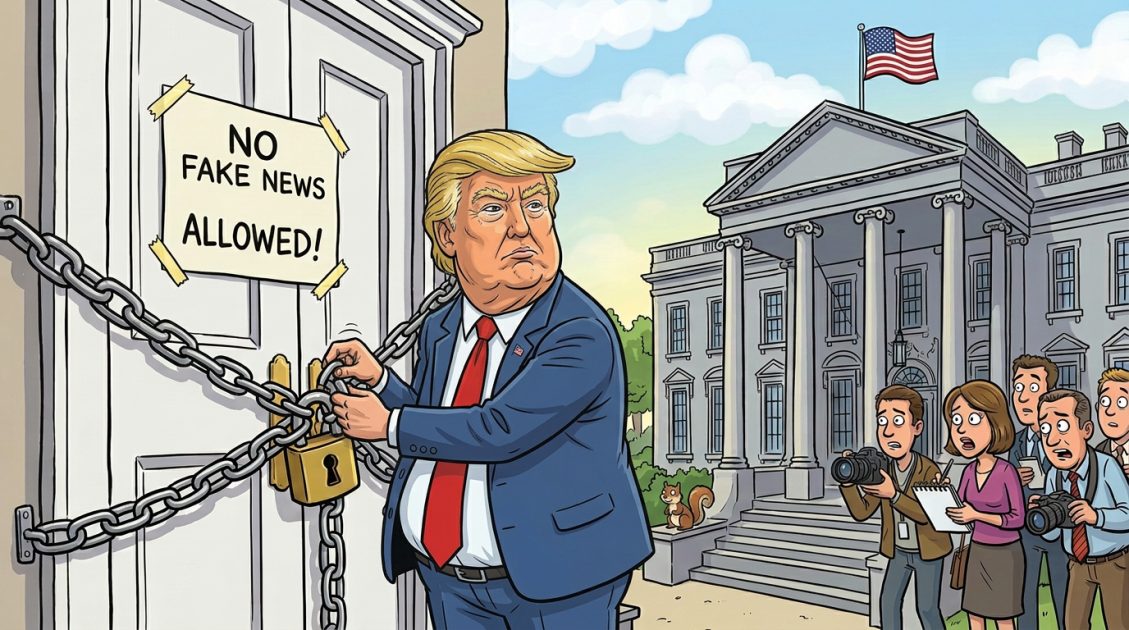
On Friday, the President of the United States suddenly announced via a post on a social media website riddled with sketchy ads that he was banning CNN, MSNOW, and Politico from the White House.
President Donald Trump asserted that he was doing so because these outlets traffic in "FAKE NEWS."
Trump eventually elaborated a bit:
“There’s something wrong with a country that can allow people to write purposely negative stories,” Mr. Trump told reporters in the Oval Office, shortly after he announced his ban, “effective immediately,” in a post on Truth Social.
“Now, if they want to write them, that’s fine, but I don’t have to let them into my — into the people’s house,” the president added.
It was not immediately clear what such a ban meant in practice. According to the New York Times, "Journalists from those news outlets were working as usual on the White House grounds on Friday, and there were no signs of an imminent eviction."
Eventually, at least some reporters were denied access to the White House.
Akayla Gardner, a correspondent for MS NOW, said that her White House-issued access badge failed to work on Saturday at the security entrance where reporters typically enter near the West Wing.
“The officer asked me to hand over my badge; he said that it was disabled,” Ms. Gardner said in an on-air interview. “I asked why I could not get inside; he said it was above him.”
In a sign of the surprising nature of Mr. Trump’s ban, an MS NOW producer was allowed into the White House, even as a photographer for the network was also asked to relinquish his badge, Ms. Gardner said.
On Monday, Trump again addressed the issue on social media.
This came on the heels of his professional and mature Sunday follow up.
In response, the three banned news outlets sued Trump for violating the First Amendment. Additionally, major television networks agreed to "suspend their pooled coverage of President Trump." ABC, CBS, CNN, Fox News, and NBC released a joint statement, "The public has a vital interest in receiving accurate, independent information about its government. No administration should restrict a news organization because it objects to its reporting."
Who knows what the courts will say on the matter or whether Trump might back down first? Either way, his decision is obviously improper and runs counter to the spirit of the First Amendment and of a free and open country.
The First Amendment to the US Constitution says, "Congress shall make no law [. . .] abridging the freedom of speech, or of the press. . . ." The idea is that the only way for the people to remain in ultimate control of their government and their own affairs if for people and news outlets to have a nearly unrestricted right to say or publish whatever they want, no matter how wrong or unpopular. Once you allow the government to restrict what people say and publish about it, you allow the government to hide information and avoid accountability.
Obviously, the President and other government officials must have some degree of control over who can enter areas otherwise off limits to the public to gather and report news. Otherwise, terrorists and other bad actors would be able to easily attack top officials and facilities and otherwise disrupt public business. Additionally, there is only so much space available.
But government officials should not choose who gets access based on the content of what is said or reported. Once you allow the President to restrict press access based (supposedly) on his assessment of what reported news is untrue or unfair to the government, you have not only essentially ceded the right to say or report what you want, but also the right of the people to oversee and control their government.
Putting aside how characteristically unserious and juvenile Trump acted in this matter, his actions are dangerous. He claims to "cherish" a free press while he literally oppresses the press. We certainly cannot trust an incompetent, corrupt conman like Trump (who lies as easily and dependably as he breathes and is legendary for his thin skin) with determining what is false or unfair and restricting press access accordingly.
Even virtuous people cannot be trusted to reasonably restrict what is said about themselves and the government on the grounds that what was said was false or unfair. First, humans naturally act biased in their own favor, even when they try not to. Second, there is essentially never broad agreement as to what is true or fair, and sometimes the minority ends up being correct. Even if one is unnaturally disciplined in only penalizing people for saying or reporting things that most people think are false or unfair, you will inevitably end up accidentally suppressing the truth in some situations and harming society as a result.
Regardless of whether you generally like and support Trump, you should recoil at this action as an affront to what this country stands for and what keeps it free. Even if you do not understand or agree with the idea of a free press and free speech being am important check for the people on government authority, you should understand what a terrible precedent this sets. If Trump can get away with oppressing news outlets that say things he does not like, what do you think the next Democratic president might do?
Every terrible precedent set by Trump in abusing his authority or exercising authority he does not possess can and likely will be used eventually by a Democratic Party president. If you view politics as nothing more than a power struggle between two groups of people in which the ends always justify the means, you should be worried about how Trump's actions can be used against you and your party in the future.
It is heartening to see large media outlets, including Fox News, band together in opposition to Trump's action, at least for now.