Earlier this week, US Army Secretary Dan Driscoll submitted his resignation to President Donald Trump. Various news outlets had reported that Driscoll and Defense Secretary Pete Hegseth had been butting heads for months.
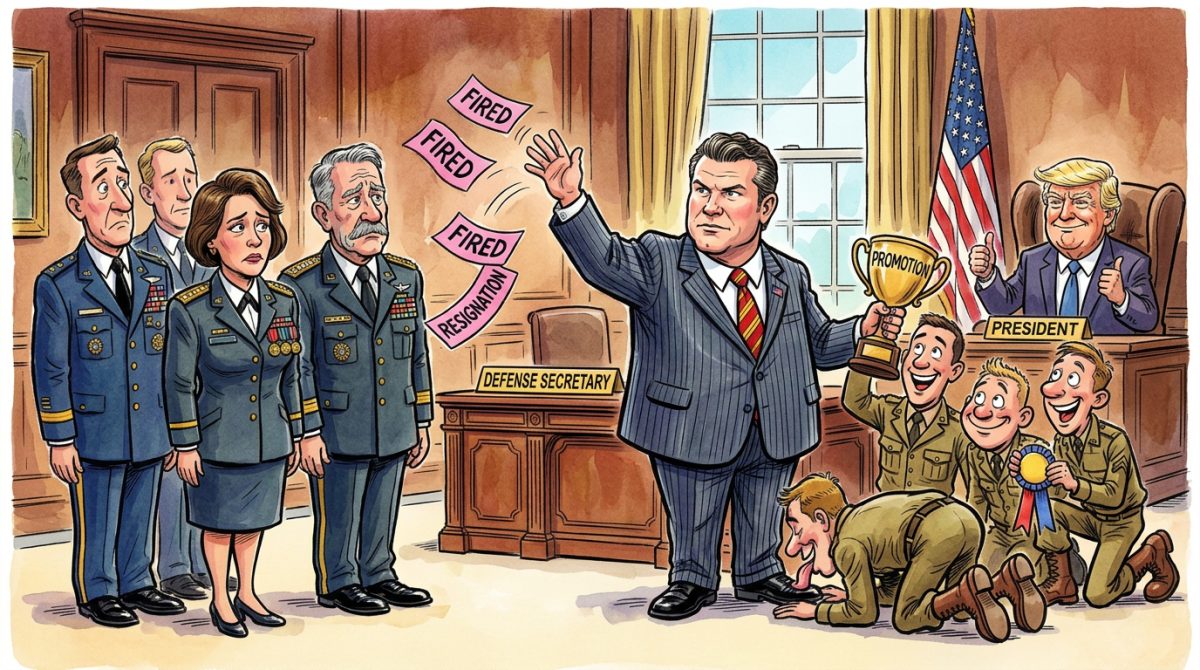
Driscoll's departure is another example in a troubling of trend of firings and resignations of top US military officials. According to the BBC,
Driscoll is the latest in a string of recent high-profile military leaders to depart, including Navy Secretary John Phelan who abruptly quit in April.
Other notable departures include Army Chief of Staff Randy George, Army Gen David Hodne and Maj Gen William Green.
Since entering the Pentagon, Hegseth has fired more than a dozen senior military officers, including the chief of naval operations and the Air Force's vice-chief of staff.
According to CBS News, "At least 20 generals, admirals and civilian defense leaders have been fired or have departed their jobs since Pete Hegseth became defense secretary at the beginning of the second Trump administration."
Further,
Some of the military's most decorated leaders have either been fired by Hegseth and President Trump or have retired with little explanation, including the Army, Navy and Air Force's highest-ranking officers and the leaders of key units. The Army and Navy's top civilian leaders have also either been forced out or resigned.
Before becoming defense secretary, Hegseth had criticized military officers, accusing them of being too focused on diversity initiatives and insufficiently supportive of frontline service members. Before he was nominated, he said on a podcast that "any general that was involved — general, admiral, whatever — that was involved in any of the DEI woke s*** has got to go."
The Trump administration has pushed out top female and Black officers, and Black and female officers have been disproportionately removed from promotion lists, a source familiar with the lists told CBS News. There are currently no active four-star women generals or admirals in the military. Many of those who failed to secure promotions have left the military.
According to ABC News, as part of his resignation, Driscoll warned Trump about Hegseth's handling of military leadership,
He told Trump that Hegseth's chaotic removal of some of the Army's most experienced leaders, often with little or no explanation, was hurting the force and shrinking the pool of officers available for future senior commands, one of the sources explained.
Trump appeared surprised by the extent of the problem, the source said.
This is all very concerning. The United States has a proud tradition of civil leadership and civil control of the military. History is littered with examples of militaries interfering in the civilian control of their nations or even taking control of their nations.
In the United States, we have successfully avoided this through careful governmental design, tradition, and probably a bit of luck. While the president is ultimately the commander in chief of the military, he is a civilian, elected by the people. He also does not have unrestricted control over the military. Instead, Congress has ultimate authority to declare war, decide whether the military can be deployed, fund (or defund) the military, and manage the details of how big the military is and how it is arranged.
Additionally, when Americans become soldiers, they swear an oath, not to the president or any other individuals, but to "support and defend the Constitution of the United States against all enemies, foreign and domestic."
This is part of why the gradual, unlawful assumption of the authority to initiate military action by US presidents over the last 100 years, including Trump's blatantly illegal war with Iran, the attack on Venezuela, and attacks on alleged drug boats, has been so concerning. We are gradually eroding the separation of powers that reduces the likelihood of the military becoming too loyal and supportive to a single president and insulates us from a military-assisted coup.
While few would argue that the president, as commander in chief of the military, and his staff should not be able to decide who occupies positions of authority within the military, there is a point where the manner in which he and his staff make these decisions becomes cause for concern.
Donald Trump has shown a clear disregard for the Constitution, elections (that he loses), and the nation's tradition of a peaceful transfer of power between elected presidents. Hegseth and Trump seem to be instituting a military culture in which loyalty to Trump is paramount and not loyalty to the Constitution and nation. They have sent the message that blind obedience to orders from leadership, no matter how immoral or unlawful, will be rewarded with prestigious positions while moral conduct and loyalty to the Constitution and laws of the nation will lead to being marginalized, fired, or criminally investigated. Even if some top military officers are not loyal to the president over the country, many will be cowed into silence and following unlawful or immoral orders.
This culture of loyalty to the president has carried over to how individual members of the military are treated for making public comments. If you are (or, like Mark Kelly, were) in the military and say negative things about Trump, or even simply report negative truths, you better beware. If you are publicly supportive of Trump and his actions, you will not face similar consequences and may get a cushy job on the federal civil payroll.
Having top military officials be more loyal to the current president than to the country at large will likely cause several problems. First, if the president or his allies try to engage in unlawful behavior, such as to interfere in an election, prevent the peaceful transfer of power following an election, or illegally deploy the military to oppress Americans, presidential loyalists in the military are more likely to look the other way or even assist in the unlawful conduct. As this president has already flirted with or engaged in this type of conduct in the past, having more loyalists in top military positions is especially alarming.
Second, military loyalists are less likely to give honest, informed, sober opinions and guidance to the president. If you gained your position by always supporting and saying yes to the president and his staff, you may not be qualified to properly assess and provide good guidance on a particular situation. Even if you are qualified, you are unlikely to tell the president what he needs to hear for fear of how it will affect your standing and career.
For instance, according to the Washington Post,
A Wall Street Journal investigation published last week found that the intelligence community accurately warned of the risks [of attacking Iran] and Vice President JD Vance counseled against the conflict. But Trump was apparently won over by Hegseth, Joint Chiefs Chairman Gen. Dan Caine and Adm. Brad Cooper, head of U.S. Central Command, who briefed him on plans to cripple Iranian forces. According to the Journal, Hegseth and Caine assured the president “they would navigate any complications.”
Ultimately, theses problems are the fault of the American people. We elected Trump to a second term knowing that he had tried to overturn an election, egged on and permitted an insurrection at the capitol, prioritized loyalty to him over loyalty to the Constitution and nation, and would likely order the military to engage in unlawful conduct. We elected Senators who rubber-stamped Trump's appointment of Hegseth as Defense Secretary despite him being perhaps the most unqualified appointee in the nation's history.
If the American people do not understand or value having a military that is loyal to the Constitution instead of the current president and of having top military officials who are not afraid to tell the president why what he wants to do may fail, then we do not deserve to have them.