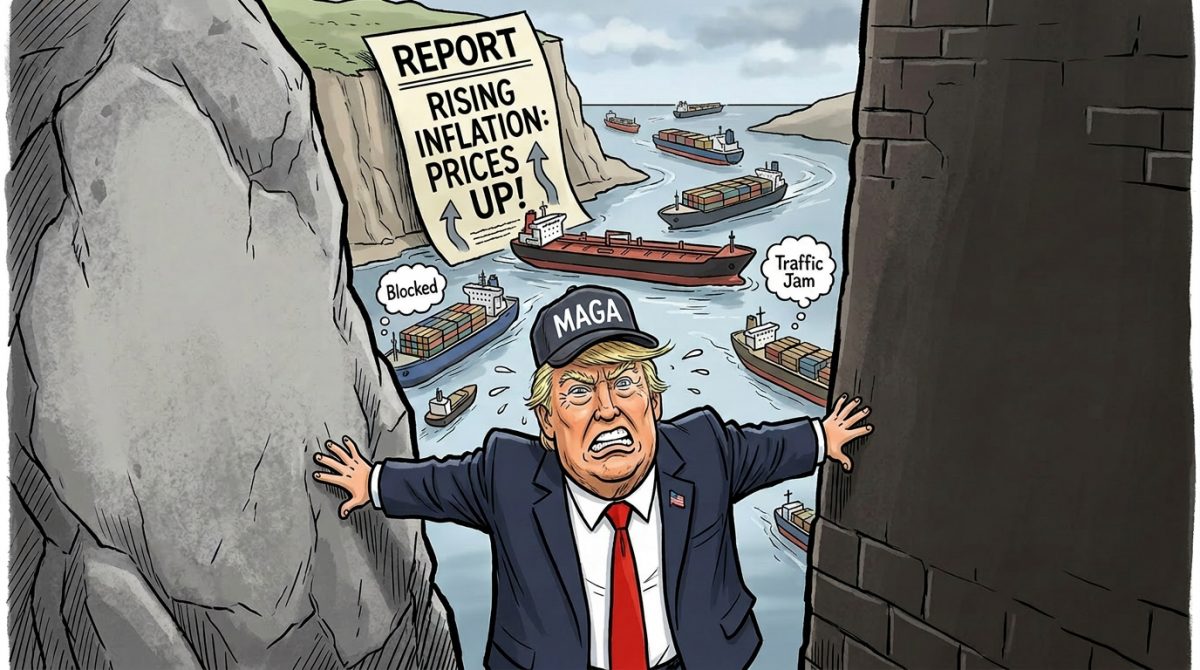
On Wednesday, reports indicated that consumer prices had increased 4.2% over last year, the biggest year-over-year increase in three years. In other words, life is 4.2% more expensive for Americans than it was only 12 months ago.
A significant portion of this is likely because of the increase in oil price prices due to the war in Iran and the fiasco in the Straight of Hormuz. According to the New York Times, fuel oil prices are up 58.9% and gasoline is up 40.5% compared to a year ago. As it takes oil and gas to transport food and goods around, nearly everything is significantly more expensive than before the war. This is all apparently fine and good with President Donald Trump.
And what has the US gotten in return for bearing this burden? A war almost nobody wanted that has accomplished almost nothing, additional stresses on the global energy supply that may be long-lasting or even permanent, a higher cost of living, and endless "negotiations."
It has become clear that Donald Trump and the toadies who encouraged him to wage the war in Iran miscalculated dramatically. Trump seems to have believed it would be possible to topple the hostile regime in Iran and encourage some sort of western-friendly revolution in a matter of weeks or days while only engaging in bombing. Instead, the ruling regime seems entrenched and just as hostile as ever. We traded an elderly, extreme, and hostile leader for a younger, extreme, and hostile leader.
Meanwhile, Iran took quasi-control over a strait through which roughly a quarter of the world's oil travels and continues to menace the region.
In response, the man who prides himself on deal-making all but declared victory and agreed to a ceasefire to essentially hammer out the terms of Iran's surrender. What did he receive from Iran for agreeing to the ceasefire? Promises to negotiate. Why you would take your foot off the neck of an allegedly defeated opponent to negotiate is unclear.
Since then, we have negotiated and negotiated with Iran, with Trump repeatedly asserting we are on the verge of some sort of amazing "deal." But somehow, we never seem to get there. Intermittently, Trump blusters about resuming the war and ending Iranian civilization, presumably as some sort of bargaining tactic, but he never follows through. Instead, Iran has had time to restore significant parts of its war-making abilities, the cost of living continues to rise for Americans, and the war gets more unpopular.
The ceasefire and negotiations have lasted longer than the active part of the war. One cannot help but suspect that the Iranians, who have eyes with which they can see how unpopular and how hard the war is on the American and world economies, are just stringing things along in the hope Trump will lose patience (or interest) and/or feel pressure enough to agree to terms favorable to Iran.
Today on social media, Trump is performing his greatest hits.
Claiming Iran's military is essentially worthless and the nation defeated. Asserting Iran will "pay the price" because Iran is taking too long to negotiate a deal that is "great for them.
This once again raises obvious questions: Why are we negotiating at all with an utterly defeated nation? Why does a nation with no functioning military have a say in what happens next? Why would we agree to a deal with such a bully nation that is "great" for the bully?
Asking the most rudimentary questions and exercising the bare minimum critical thinking is all it takes to realize that Trump is lying. If Iran was utterly defeated, we would not need to strike a deal with them. We would not need anything from them. We would be imposing our will on Iran, and Iran would not be posing serious danger to our interests, its neighbors, or the world economy.
The reality is that Iran is clearly not defeated in any meaningful sense of the word. The US occupies no land in Iran. Iran maintains its ability to harm oil-production in the middle east and ships navigating the Strait of Hormuz. Iran has nearly unfettered ability to stop the flow of a quarter or more of the world's oil and is exercising it.
In contrast, it is clear that the Trump is desperate to make this war stop. His expectations about the ease and outcome of the war were terribly wrong. His refusal to understand or acknowledge the ease with which Iran could and would be willing to close the Strait of Hormuz is proving catastrophic. A master negotiator who has all the leverage in negotiations does not make repeated public threats without following through. He does not agree to negotiate endlessly. He does not talk about how great the deal is for his opponent.
The US does have some leverage in the form of potential military might and a blockade preventing Iran from selling most of its oil. But contra Trump, as mentioned above, Iran retains massive leverage. The war has been very expensive to the US taxpayers. The war is very unpopular in the US. It is costing Americans big time in the form of higher prices. Iran retains significant control over the flow of oil to the world and poses a legitimate threat to oil production in the region. Americans are likely not willing to send in ground forces to impose their will on Iran. The US's war-making ability is severely reduced and may be for years.
This is all clear as day to Iran and anyone who is not blindly loyal to Trump. What is the US even trying to achieve at this point? Have Iran agree to let shipping traffic freely flow through the strait and stop developing nuclear weapons? This was essentially the status quo at several points over the last decade. What a waste of money, resources, and lives.
Why would Iran agree to this? In some ways, like its control of the Strait and clear US hesitance to continue the war, it is in a stronger position than it was before the war. Why would Iran give up significant leverage to help restore the pre-war status quo, particularly when there are reasons to think that Iran might be able to bear the pains of the war better and longer than Trump and the US?
Obviously, Iran is hoping to string Trump along until he gets desperate enough to cut a deal with Iran that puts Iran in a better position than it was before the war, such as the US acknowledging Iran's right to collect tolls from ships passing through the Strait, granting sanctions relief, and paying reparations for damage from the war.
How do Trump and the US resolve the war with Iran and the trouble in the Strait of Hormuz without essentially capitulating to Iran? Unless circumstances change and pressure from the blockade gets Iran to give up first, which seems to be Trump's last hope, it seems like the only two paths forward for the US are giving Iran a sweetheart deal or resuming (or even escalating) the war. Both seem like major political losses for Trump and Republicans, which is probably why Trump has spent months doing little more than oscillating between impotent blustering and empty Art of the Deal spinning while hoping the blockade delivers him a miracle.